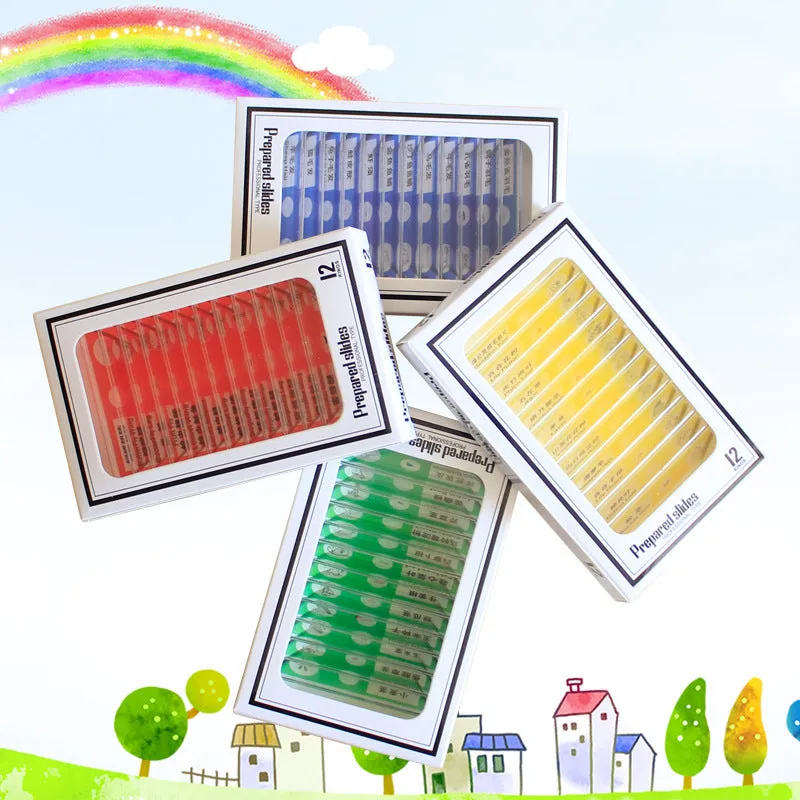
Plastic Microscope Slides for Children's Observation, 48-Piece Set with Four Colour-Coded Sections Featuring Plant Rhizomes, Animal Hair, Flower Petals, and Prepared Specimens for Educational Biology Study


Plastic Microscope Slides for Children's Observation, 48-Piece Set with Four Colour-Coded Sections Featuring Plant Rhizomes, Animal Hair, Flower Petals, and Prepared Specimens for Educational Biology Study
48-Piece Children's Microscope Slide Set with Colour-Coded Plant and Animal Specimens

This comprehensive 48-piece set of polystyrene microscope slides is designed specifically for children's educational use, providing a structured introduction to biological observation. The collection is logically organised into four distinct colour-coded series, each dedicated to a specific category of natural specimens, from detailed plant cross-sections to animal fibres. This system aids in easy identification and focused study, making it a practical tool for home learning or classroom environments where clear categorisation supports understanding. The slides feature permanently mounted and processed samples, ready for immediate use under a standard microscope without the need for complex preparation.
Features and Construction

The set is built around a clear organisational principle, with every slide belonging to one of four colour-coded groups. This construction supports systematic learning by allowing young users to compare specimens within a category or explore differences between groups. The physical slides are made from polystyrene, a material chosen for its optical clarity and durability under typical handling conditions.
Material and Build
All slides are constructed from polystyrene, a type of rigid plastic that provides a stable, flat base for the mounted specimens. This material offers sufficient transparency for clear microscope viewing and is less fragile than traditional glass slides, making it more suitable for use by children. The specimens themselves have undergone a special mounting process, as noted in the source for the plant sections, which are cut and prepared for observation.
Size and Practical Fit
The complete set comprises 48 individual slides, providing a substantial number of specimens for repeated observation and study. While exact slide dimensions are not specified, they are designed to be compatible with standard microscopes used in educational settings. The division into four colour-coded boxes—red, green, yellow, and blue—not only categorises the contents but also offers practical storage, keeping the collection organised and portable.
Uses and Placement

This product serves as a dedicated resource for hands-on biology education, bridging the gap between theoretical learning and practical observation. Its structured design makes it applicable in various settings where introducing children to the microscopic world is the goal.
Event or Professional Use
In formal educational environments like primary school science classrooms or after-school clubs, this set provides a ready-made resource for group activities or individual projects. The colour-coding allows an instructor to easily assign a specific theme—such as 'plant structures' using the green box—for a focused lesson. The prepared nature of the slides, including processed cross-sections of rhizomes and stems, saves valuable teaching time that would otherwise be spent on specimen collection and preparation.
Everyday Home Use
For parents supporting home education or encouraging a child's interest in nature, this set offers a straightforward, self-contained science activity. A child can systematically work through one colour box at a time, comparing the insect parts in the red box with the animal hairs in the blue box, for example. The inclusion of familiar items like pumpkin sections, onion layers, and cat hair can make microscopic exploration more relatable and engaging for young learners.
Benefits and Buying Value

The value of this product lies in its combination of volume, organisation, and ready-to-use specimens, which together reduce barriers to practical biology education.
Reuse and Low Maintenance
The polystyrene slides are durable and the specimens are permanently mounted, meaning the entire set can be used repeatedly over time. Unlike temporary slides that require fresh material, these prepared slides offer consistent reference points for learning. Maintenance is minimal, requiring only careful handling and storage in the provided boxes to keep the collection intact and organised for future use.
Why Choose This Product
This set is distinguished by its explicit educational design, seen in the logical colour-coded categorisation of specimens into plant, animal, insect, and flower groups. The inclusion of specially processed cross-sections, such as the longitudinally or transversely cut plant rhizomes and stems in the green box, provides views that are difficult to achieve without specialist equipment. With 48 slides covering a defined range of biological themes, it offers a broad yet structured sampling of natural materials specifically selected for a child's observational learning.