
Forklift Hook Rotatable Drum Crane Locking 25 Tonne Attachment MK Forklift Hook Mobile Crane Accessory with Safety Lock Adjustable Fork Installation Iron Construction 6 kg Weight 500 kg Capacity


Forklift Hook Rotatable Drum Crane Locking 25 Tonne Attachment MK Forklift Hook Mobile Crane Accessory with Safety Lock Adjustable Fork Installation Iron Construction 6 kg Weight 500 kg Capacity
MK Forklift Hook: A 500kg Capacity Rotatable Crane Attachment for Forklifts

The MK forklift hook is a practical industrial attachment engineered to expand the functionality of a standard forklift, effectively turning it into a capable mobile crane. This accessory addresses the need for versatile lifting solutions in warehouses, construction sites, and logistics centres where moving heavy, awkward loads is a regular requirement. By mounting directly onto the forklift's forks, it leverages existing machinery to perform crane-like duties without the need for a dedicated crane vehicle. The design prioritises operational security with a built-in safety locking device and allows for adaptable lifting angles thanks to its rotatable hook. With a stated load capacity of 500 kg and a robust iron construction weighing 6 kg, it is built for demanding industrial environments. Users must, however, always reference their forklift's specific load attenuation curve to ensure safe operation within the combined limits of both the hook and the host machine.
Features and Construction

This forklift hook attachment is defined by several key mechanical features and a straightforward, durable build. Its primary purpose is to provide a secure lifting point that integrates seamlessly with a forklift's existing lifting apparatus, the forks. The construction and design choices focus on practicality, safety, and providing a clear upgrade to the forklift's standard capabilities.
Material and Build
The MK forklift hook is fabricated from iron, a common material choice for industrial lifting equipment due to its strength and cost-effectiveness for high-stress applications. The 6 kg net weight indicates a substantial build that can withstand the forces involved in lifting loads up to its 500 kg capacity. The design incorporates a locking column, a critical component for firmly attaching the hook unit to the forklift's tines, preventing slippage or movement during a lift. The assembly does not include complex electronics or hydraulics, relying on mechanical integrity for its function.
Size and Practical Fit
The source information specifies the product's weight (6 kg) and load capacity (500 kg) but does not provide physical dimensions like length, width, or hook opening size. This indicates the product's suitability is primarily defined by its weight rating and compatibility with forklift forks, rather than its spatial footprint. The "adjustable installation" feature suggests the attachment can be mounted at various positions along the length of the forks, allowing operators to fine-tune the centre of gravity or reach for different tasks. The lack of specific dimensional data means users should confirm the physical size is appropriate for their intended forklift model and working space.
Uses and Placement
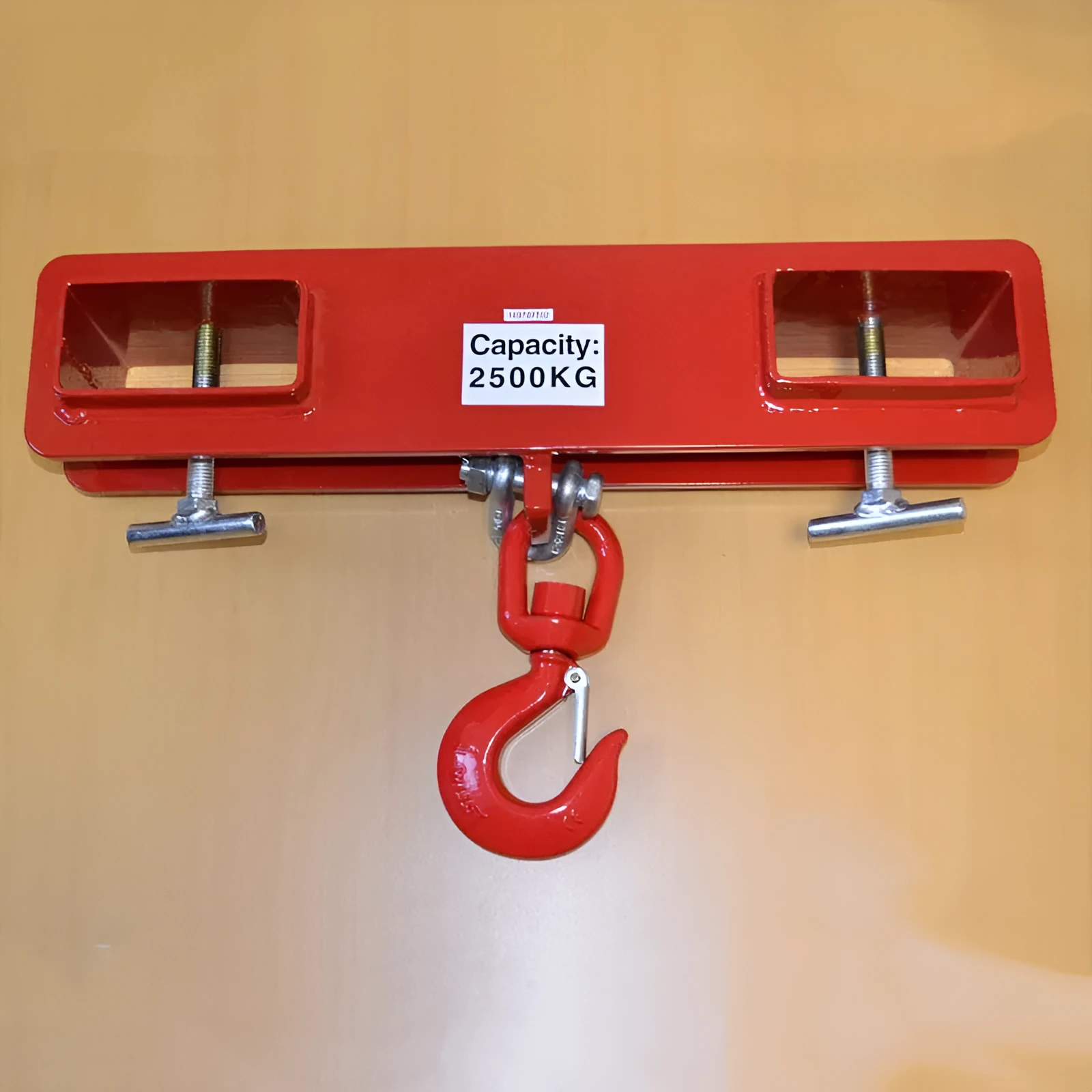
The transformation of a forklift into a mobile crane opens up a range of applications beyond simple pallet transport. This hook attachment is suited for scenarios where loads need to be lifted vertically from above or manoeuvred with more precision than fork-tyne placement allows. Its utility spans both planned industrial operations and more ad-hoc material handling needs.
Event or Professional Use
In professional industrial, construction, or warehouse environments, this attachment is valuable for tasks like lifting machinery components, positioning building materials, or handling large, non-palletised items. It enables a single forklift to perform multiple roles, potentially reducing the need for additional specialist lifting equipment on site. The safety lock and rotatable hook are particularly important in these settings, where load security and precise placement are paramount for both efficiency and workplace safety. The requirement to follow the forklift's load attenuation curve is a critical professional practice to prevent accidents.
Everyday Home Use
While primarily an industrial tool, this product could see use in larger-scale agricultural settings, at workshops, or in small manufacturing units where a forklift is available. It could assist with tasks like lifting engines, moving heavy equipment, or handling bulky supplies. For non-professional users, the clear safety warnings and the necessity of understanding the combined weight limits of the forklift and hook are even more crucial. Its use is contingent on having access to a suitable forklift and operating it within a safe, controlled environment.
Benefits and Buying Value

The value of the MK forklift hook lies in its ability to add significant functionality to an asset many businesses already own—the forklift. It represents a cost-effective alternative to purchasing a separate crane for occasional or supplementary lifting duties. The benefits are rooted in practicality, versatility, and the extension of existing equipment's useful life.
Reuse and Low Maintenance
As a mechanical attachment made from iron, it is designed for repeated use over time with minimal maintenance requirements typical of such components—primarily involving periodic inspection for wear, damage, or corrosion. Its durability is a function of its solid iron construction and lack of moving parts beyond the rotation mechanism and lock. The product does not require power, batteries, or complex servicing, contributing to a long service life with simple upkeep. Its value is realised each time it is used to complete a lifting task that would otherwise require a different machine or method.
Why Choose This Product
This product is a logical choice for forklift operators or site managers needing a reliable, mechanical solution for overhead lifting. Its straightforward design with a safety lock and rotatable hook offers practical advantages over simple, unsecured hooks. The stated 500 kg capacity and iron build provide clear parameters for its use. The key differentiator is its specific design as an adjustable, lockable attachment for forklift forks, turning a common piece of material handling equipment into a more versatile tool. Potential buyers should select it based on this defined purpose, its rated capacity matching their needs, and the presence of safety features supported by the source text.
